

Share
BALDER: THE NORSE GOD OF LIGHT AND JOY
Balder, son of Odin and Frigg, was the most handsome and cherished of the gods, a radiant embodiment of light and truth. Yet, not all revered him. The mischievous Loki, in a plot of deceit, orchestrated Balder's tragic demise, a tale that stands as one of the most renowned in Norse mythology.
Balder's prophetic dreams
Balder's dreams were the harbingers of his tragic fate. Balder began to have premonitory dreams about his own death. These dreams filled him with worry and anguish, as in Norse mythology, dreams were not mere fantasies, but profound glimpses into the future, often carrying dire implications.
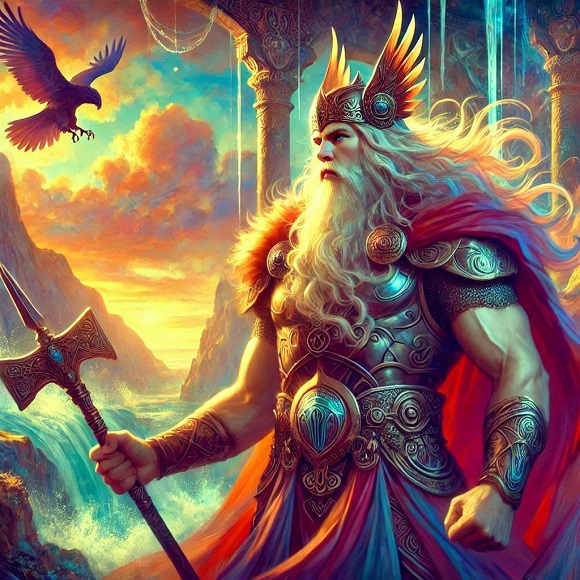
To unravel the mysteries of Balder's dreams, Odin, his father, descended into the underworld on his steed. There, amidst the chaos, he invoked a spell, rousing the fearsome Hela, the Mistress of the Dead, from her subterranean realm.
However, longing to return to the quietude of the dead, Hela offered a cryptic and vague interpretation, her words as hazy as the underworld she ruled. Disinclined to offer a clear warning, she ensured that the dream's portent remained obscure.
Night after night, Balder's dreams became more and more troubled. He would toss and turn in his bed, tormented by frightful visions of darkness. The god, renowned for his cheerfulness, was transformed into a brooding figure, his joy replaced by a deep and abiding sorrow.
When questioned about his distress, he revealed that his sleep was plagued by nightmares. The gods began to worry seriously, and they gathered in Gladsheim to devise a solution. Together, they compiled a comprehensive list of everything that could possibly harm Balder, from the deadliest weapons to the most insidious diseases and even the smallest of plants.
With the list complete, Frigg embarked on a journey through the nine realms, seeking a solemn oath from every creature not to harm her beloved son. However, she overlooked the mistletoe, deeming it too young and innocent to make an oath.
Loki the Trickster
Consumed by resentment after his sons were abducted by the gods to prevent further harm to both deities and mortals, Loki resolved to avenge himself by taking the life of Balder.
For a long time, he roamed the realms, searching for something that had not promised not to harm Balder or that could break his promise, and when he finally lost hope, because he could not find anything, he turned to Frigg herself for answers.
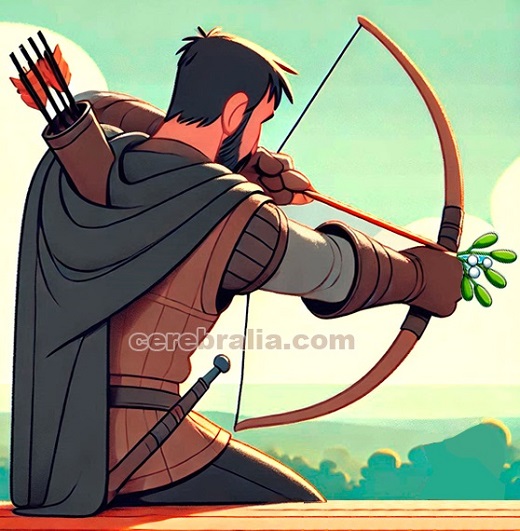
With cunning guile, Loki transformed himself into an aged woman and approached Frigg, relentlessly pestering her until she revealed that the only thing that had not promised not to harm her son was the mistletoe. Loki then went to the forest, picked a large branch of mistletoe, and made an arrow from it.
The death of Balder
Loki returns to the assembly of the gods. There, everyone was throwing sharpened darts at Balder. They gawked in amazement at how their makeshift weapons were harmless. Balder was confident that no harm could come to him.
Loki went to Balder's blind brother, Hodr, god of darkness, who was in a corner because he couldn't aim and therefore couldn't participate in the test of Balder's invulnerability. Loki told Hodr he would help him take aim. Hodr was grateful and accepted the offer.
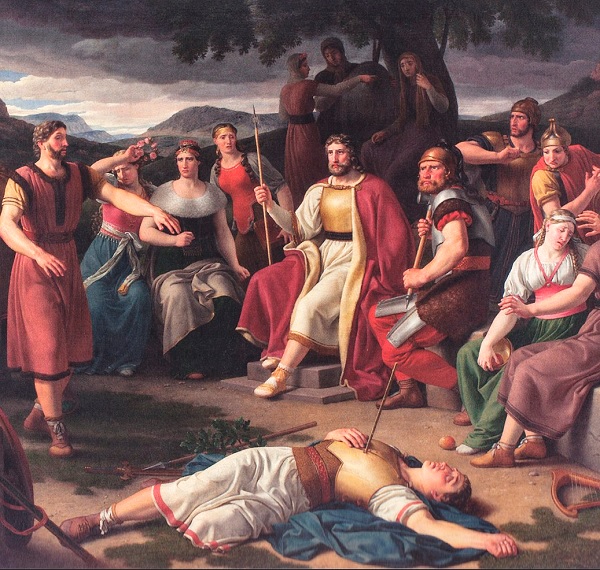
Loki pretended to help Hodr, giving him the mistletoe dart and guiding his hand. When the dart struck Balder it killed him immediately, throwing the gods into confusion. The gods looked towards Hodr and saw Loki beside him. Before they could do anything, Loki fled away.
Celebration turned to lamentation since the most beloved of the gods had died. Odin alone was aware of how disastrous this event really was for them all, for he knew that with the loss of light and truth, the end of the world, Ragnarok, was due soon.
The death of Hodr
Vengeance was demanded for Balder's unjust death. Yet, Odin could not bring himself to harm his son Hodr. Seeking guidance from an oracle, he was told that the avenger would be born of a giantess of ice named Rind. Odin descended to Vestsalir and took the giantess. From this union a son named Váli was born.
The child grew rapidly from the moment of his birth. On his first night of life, without even having combed his hair or washed his hands, he set off for Asgard, and with deadly aim, he killed Hodr with his bow and arrow.
The punishment of Loki
In a desperate plea to reclaim her son, Frigg vowed to reward anyone who would venture into the underworld. Hermod, answering her call, journeyed for nine days and nights until he reached Helheim. There, Hela, the goddess of death, declared that Balder's release hinged on one condition: every creature and thing in the world must weep for him.
And so all things wept, save for one. Thok, a giantess, refused to mourn Balder's passing. It was her refusal to weep that sealed his fate in the underworld, ensuring he would remain there until Ragnarok.
When the gods discovered that the giantess was actually Loki in disguise, they hunted him down and tied him to three rocks. A venomous serpent was suspended over him, its poison dripping relentlessly onto his face.
Loki's wife, Sigyn, did her best to alleviate his suffering by catching the dripping venom in a bowl. But occasionally, she had to empty it, and whenever the poison touched his skin, he would convulse in pain, causing earthquakes.
The significance of mistletoe
In the wake of Balder's tragic demise, Frigg vowed that mistletoe would forever be transformed from a weapon of death into a symbol of love and reconciliation.
Frigg's tears, filled with both grief and hope, imbued the mistletoe with a new meaning. It became a representation of life's resilience and the possibility of healing after loss.
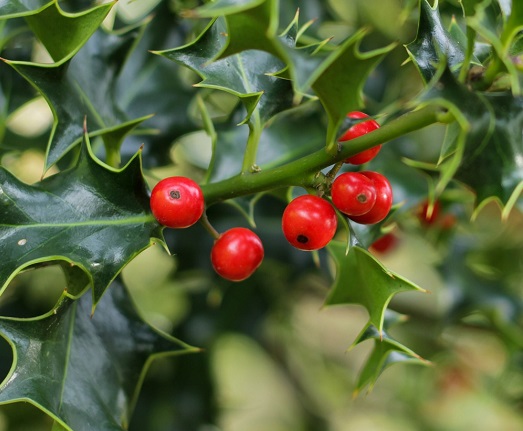
The transformation from a fatal plant to a symbol of love underscores how love, even when it leads to heartbreak, can also be the catalyst for healing and renewal.